
Why Americans Need Everything to Be Worth It
On cancelled meetings, Sunday lunches, and the cost of treating time like currency.

A few weeks ago, I had to cut short a meeting with a fellow Substack writer I'd been looking forward to for a while.
Rich Kagan was in Paris, we had found a time that worked for both of us, and then a work appointment came up that I felt I couldn't move. So I cut the meeting short, apologized, and went to the appointment.
The work appointment was legitimate. The decision was reasonable. And yet weeks later I’m still turning it over, still arriving at no clear answer.
Maybe the problem isn’t the decision. Maybe it’s the question.
Because is it worth it? sounds like asking the right thing. It sounds grown-up, like you’re being careful with something finite. But underneath it is a transaction: what do I get back for what I put in? And once that starts, it goes everywhere. Trips. Dinners. Friendships. The coffee that might run long. The invitation you’re not sure about. At some point life starts to feel like a portfolio, and every choice is an allocation that needs to justify itself before you say yes.
I notice it most in June.
For parents in France, June is what Americans call Maytember — the month where everything happens at once and the calendar becomes an emergency. End-of-year concerts, class parties, teacher gifts, sports finals, birthday parties stacked on birthday parties.
French mothers are just as overwhelmed as I am this time of year, which tells me the chaos itself isn’t cultural.
What feels different is how I move through it.
I am constantly weighing. Is this worth rearranging the week for? Can I justify three hours on this? If I say yes to that, what am I saying no to?
Meanwhile, my French friends seem to just go.
And then the next day, tell me whether it was lovely or not — and they always say it was, because optimism is polite here. But that’s a conversation for another time.
I’ve been thinking about that difference for a while, and the more I sit with it, the more I think it goes deeper than how the French relate to time. It goes to what we think time is for in the first place.
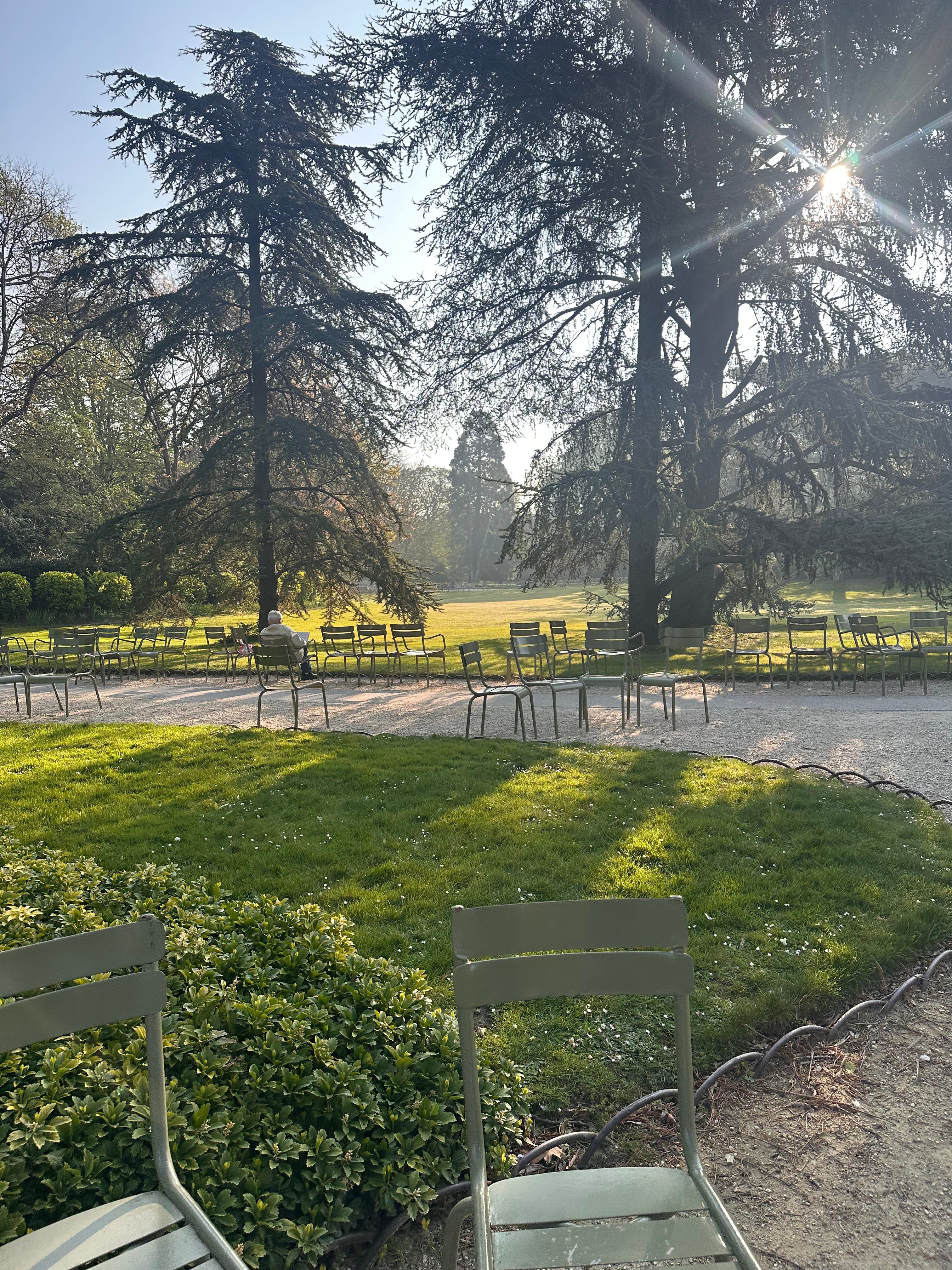
I don’t usually ask whether something will be enjoyable. I ask whether it will be worth the time. Which sounds similar until you realize they’re completely different questions. One is about experience. The other is about return.
And once you start expecting a return, life becomes surprisingly expensive.
I think about the Sunday lunches here. French families sit down around one in the afternoon and surface again around six or seven, sometimes later. The conversation finds its own pace. A cheese course appears. Someone opens another bottle because why not. The children disappear into another room and nobody calls them back. At some point you notice the light has changed and you’ve been sitting there for hours and it didn’t feel like anything was being spent.
The afternoon was the point.
For a long time, I read this as a luxury — something you could only afford if you weren’t busy enough. I don’t think that anymore. It’s a different premise entirely. One assumes that time is a resource to manage. The other assumes that time is just the medium in which life happens.
I still run the calculation. My meeting with Rich is proof of that.
But what I’ve started noticing is that the things that feel most worthwhile afterward are almost never the things I could have justified beforehand. The conversation that ran long. The lunch that lasted all afternoon. The friend I almost didn’t make time for. The invitation I almost declined.
The question isn’t wrong exactly.
It just arrives too early.
Before the experience has had a chance to become anything, I’ve already decided what it needs to return.
And sometimes that’s enough to make sure it returns nothing at all.
As it turns out, Rich and I never got the uninterrupted conversation we were hoping for.
So we’re trying again.
This Thursday, June 25 at 3:00 PM Paris time, we’ll be going live to talk about life in France, raising children between cultures, friendship, social codes, and whatever else we inevitably get sidetracked into discussing.
You can set a reminder here.
Thank you for reading.
À très vite,
Pamela
Now that my kids are young adults, I look back and wonder why I made certain decisions: answering emails after the kids went to bed, going in to work early so could could leave by 5:30…. I look back and now realize that it’s time that I can’t get back. With my son out in his own and my daughter in college, getting the family together for a dinner and a game happens far less frequently. But maybe that’s why I stopped climbing the career ladder. The social contract between employers and employees is broken. No amount of money can ever get us time back.
It turns out it was in fact worth it for both of us. I had no doubts given our interactions here BUT I deeply understand this subject/question. I’m super grateful for the time you had. Kids, career, husband, life and all in Paris. Time is valuable. I’m glad to have gotten some of it. And…now for the live. I can’t wait!